
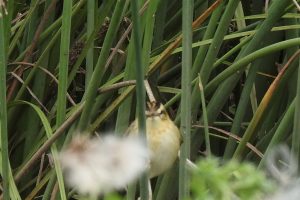
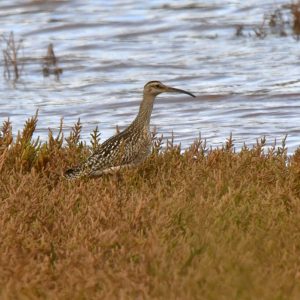
Sixteen members met at the LORP car park on a sunny morning and we were greeted by Rick Lockwood, head warden of this newly established reserve, which is part of the Pebblebed Heath trust group of reserves. He informed us of several species including Green Sandpiper, Knot and Black-tailed Godwit that had been seen recently and for us to keep a watch for them. After a short briefing we set off Easterly across the new bridge from where we could look upstream and downstream seeing Mallards in large numbers flying over heading North. Black-headed and Herring Gulls were observed on both sides of the bridge. A flock of House Sparrow moved through the reedbed before flying off in the direction of the car park and row of houses nearby and a late staying Sedge Warbler was spotted in the same area. Also seen were Little Egret and Oystercatcher, as well as several Little Grebe – both on the open water and the River Otter. In the scrub area on the southern side of the road we had Stonechat, Goldfinch and Meadow Pipit with good numbers of Swallow and House Martin flying overhead. Highlights here included a close up sighting of a Whimbrel and from the old ‘White Bridge’ upstream on the Otter we had a Kingfisher fishing from the overhanging branches of a Willow and Little Grebe and Moorhen also present.
We then walked along the path that runs between the river and the open water seeing Cormorant, Shelduck, Mute Swan , Mallard and Teal. Corvids patrolled the skies above us; species counted being Carrion Crow, Jackdaw, Rook and Raven. One of the islands had a group of Black Headed Gulls, one of which was showing leucistic plumage and provoked some debate as to whether it was a Med Gull! At the top end of the open water is a marsh and just visible through the reeds we saw a Green Sandpiper along the edge of a ditch along with two Grey Heron and Teal and Mallard. Later in the same area a group of Cattle Egret were seen. Passerines included Linnet, Robin, Dunnock, Blackbird and two beautifully glossy Ravens were showing well on the grassy area.
We returned to the car park where we had lunch and Blue, Great and Long Tailed Tits were spotted around the car park area, along with the flock of House Sparrows and several Blackbirds.
A final walk south along the edge of this newly formed channel rewarded us with a Common Sandpiper, Great Black- backed Gull, Ringed Plover and Dunlin.
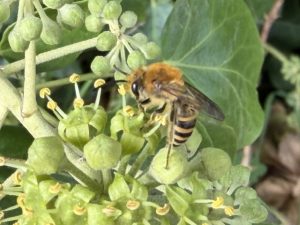
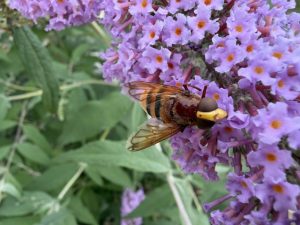
The following non-avian species were seen: Migrant Hawker and Emperor Dragonfly, Small White, Large White, Red Admiral, Clouded Yellow Butterflies, Hornet Plumehorn Hoverfly, Ivy Bee and a Rabbit.
An enjoyable meeting and we were able to appreciate the hard work that has been carried out to construct this reserve and the ongoing efforts by Rick and his team in maintaining the habitats for all wildlife.
Report by John Lloyd
Birds – 48 species seen or heard(h) : Mute Swan, Canada Goose, Shelduck (imm), Mallard, Wigeon, Teal, Little Grebe, Cormorant, Cattle Egret** (11nr), Little Egret, Grey Heron, Buzzard, Moorhen, Oystercatcher, Ringed Plover, Dunlin, Green Sandpiper, Common Sandpiper, Redshank, Whimbrel, Black-headed Gull, Herring Gull, Great Black-backed Gull, Woodpigeon, Collared Dove, Kingfisher, Great Spotted Woodpecker, Swallow, House Martin, Pied Wagtail, Dunnock (h), Robin, Stonechat, Blackbird, Chiffchaff, Sedge Warbler, Wren (h), Great Tit, Blue Tit, Long-tailed Tit, Magpie, Jackdaw, Carrion Crow, Raven, Rook, House Sparrow, Linnet, Goldfinch.
[ ** = Uncommon ]
Mammals: Rabbit
Dragonflies: Migrant Hawker, Emperor. Other insects: Hornet Plumehorn Hoverfly and an Ivy Bee
Butterflies: Large White, Small White, Clouded Yellow, Red Admiral, Speckled Wood

