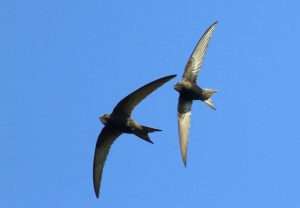
It’s May and the skies begin to reveal the iconic sights and sounds of returning Swifts from their African migratory homes. In fact though Apus apus (literally translates to “without feet” due to its predominantly airborne lifestyle) is thought of as the Common Eurasian Swift it could be argued that, with most of its life spent in Africa, it is an African species. Fossil remains show that this species has been around for 65 million years. Sadly, today we are witnessing a long term downward trend in populations and it is this that organisations and individuals like Alistair are working hard to promote conservation efforts from the wider public and both local and national governmental bodies.
This amazing bird is loyal to its partners and loyal to its nest sites and will fiercely defend a nest site year on year. Though natural nesting sites include cliff faces and tree cavities we mostly know the Swift as a mainly urban species. Some of us are lucky to have them flying and screeching around our own homes. Unfortunately with modern building techniques, materials and the drive for home energy efficiency many of the traditional potential nest sites have been eliminated. This combined with reductions in numbers of flying insects due to intensive farming practices, that bring with it landscape change, that includes the loss of ponds, hedgerows, flower meadows and tree diseases has all contributed to population decline. In Britain the Swift has been “Red listed” since 2022 this now begs the question, “who is going to save the Swift?”
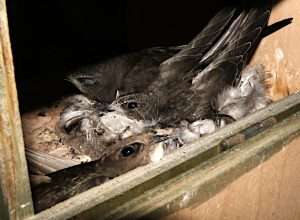
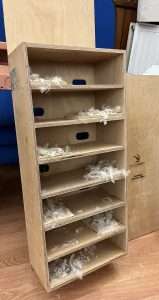
Alistair outlined what he has done in his hometown of Kingsteignton where he has installed nest boxes that are fitted with sound systems to broadcast Swift calls. After several years he has been able to see Swifts firstly investigate the boxes and subsequently adopt a number of boxes and successfully rear broods. We saw video footage where the Swifts were “banging” the boxes to flush out any inhabitants before finally being satisfied that they could occupy a box. He went on to show us examples of various types of nest box with exhibits he had brought with him.