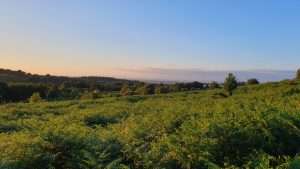
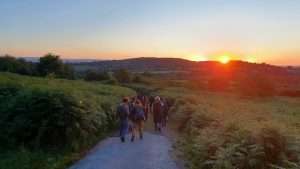
I was expecting turn-out to be low as our event clashed with the England semi-final match against the Netherlands in the Euros 2024, but we had 12 people who either couldn’t bear the agonies of watching the England men’s team play football, or just didn’t care! We assembled in the car park at Mardon Down, it was a perfect evening with a cloudless sky and fantastic visibility across northern Dartmoor and mid-Devon. Yellowhammer were singing and small flocks of Linnet moving about and occasionally singing prior to roosting, a Chiffchaff was calling and the odd Song Thrush singing. We were led by Tony and Lisa Whitehead, who between them have an excellent knowledge of this area including geology, flora and fauna and the impacts of management and management changes. We made our way down the slope from the dryer heathland at the top of Mardon Down, to the very wet culm grassland meadows on the lower land where we could really appreciate the differences in habitat, particularly the plant life and the insects and birds that these might attract.
As dusk began to fall, we congregated at a spot where Nightjar had regularly been seen. Before long, a silent flying bird was seen, which then perched on the telephone wire just yards away and treated us to several minutes of constant churring! It was quite magical to be so close to the bird which seemed completely at ease with us being there. Several bats began flying around our heads too, which Tony identified as Pipistrelle and Serotine from the frequency of their calls. A moth trap had been put out in the corner of the culm grassland paddock, but despite seeing a couple of moths flying around, nothing was in the trap by the time we left – most likely because of the low temperature and the fact that it was still relatively light at 10:30pm! On the walk back to the car park, a second Nightjar was seen, which briefly settled before flying on again. A huge thanks to Tony and Lisa for leading us for the evening.
And now back to the football…
Report by Tom Misselbrook