
Devon Birds News
Plymouth Branch’s Indoor Meeting Report Monday 28 September 2026 ‘Magic and Feathers: How Birds Work and Why It Matters’ by Dr Lucy Hawkes
Dr Lucy Hawkes, a physiological ecologist from the University of Exeter whose research has taken her from tracking sea turtles to studying Arctic Terns, Bar-headed Geese and Cinereous Vultures was welcomed to the September Indoor meeting.
Her latest project, Magic and Feathers, explores a fascinating question: how do birds achieve such extraordinary feats, and could understanding their biology help address some human health problems?
Lucy began by reminding us just how remarkable birds really are. While we admire the achievements of marathon runners, mountaineers and free divers, birds outperform us with ease. Great Snipe can sustain flight speeds of nearly 100 km/h for days at a time, Arctic Terns travel over 100,000 km annually during their migration, and Bar-headed Geese have been recorded flying at altitudes of over 7,000 metres. As Lucy succinctly put it: all birds are amazing.
The talk then explored four key areas where birds seem to have solved problems that humans still struggle with.
Weird Lungs
Flight is an enormously demanding activity, requiring a continuous supply of large amounts of oxygen. Birds meet this challenge and that of flying at high altitudes, where oxygen is scarce, by having a gas exchange system that is very different from our own. Mammalian lungs inflate and deflate and freshly breathed in air mixes with residual air in the blind ending air sacs. Bird lungs are rigid / static and work alongside an extensive network of air sacs distributed around the body. Every breath a bird takes requires two breathing cycles before the air is exhaled. Initially air passes into abdominal air sacs before passing through the lungs and then into air sacs in the thorax and neck before leaving through the nostrils. Thus, there is a one-way air flow through the lungs allowing much more oxygen to be absorbed into the blood than in mammalian lungs.
Lucy illustrated this with a memorable experiment from 1968 in which sparrows and mice were exposed to air with reduced concentrations of oxygen. While the mice became lethargic and eventually comatose, the sparrows remained alert throughout, demonstrating the remarkable efficiency of avian gas exchange.
Birds are naturally ‘diabetic’
Another surprising fact is that birds maintain blood sugar levels that would be considered diabetic in humans. Elevated blood glucose levels in humans is one of several factors that lead to oxidative stress. Oxidative stress is caused by having high levels of Reactive Oxygen Species (ROS) in cells. These are molecules that are made in cells as a by-product of respiration and at high levels result in damage to DNA and proteins and can contribute to aging, cancer, blood vessel damage and heart disease.
Antioxidants such as vitamin C render ROS harmless and prevent this damage. Birds excrete nitrogen containing waste as uric acid – the semi solid deposit on your car! If they produced urine then large quantities of water would be needed and this would make flight more challenging. Uric acid is a powerful antioxidant and so deals with ROS molecules produced in birds. This explains why birds can tolerate high blood glucose levels without suffering the harmful effects associated with diabetes.
Lucy explained how understanding these mechanisms could one day provide insights into treating diabetes-related diseases in humans.
Birds barely age
The ageing process was a further area where birds appear to have an advantage. Many seabirds enjoy exceptionally long lifespans, with the famous Laysan Albatross known as “Wisdom” reaching at least 75 years of age.
In humans, structures known as telomeres, the protective end caps on chromosomes, gradually shorten as cells divide. Upon reaching a critical short length the cell stops dividing and can become senescent. These cells then go on to release inflammatory signals which contribute to age related illnesses. Individuals with shorter telomeres have an increased risk of developing certain types of cancer. Research has focused on human lifestyles, e.g. smoking, an unhealthy diet and lack of exercise that may increase the rate of telomere shortening and so adversely affect our lifespan. Birds seem to avoid much of this decline, with their telomeres remaining far more stable over time. Understanding how this is achieved in birds could have important implications for the treatment of age-related diseases.
Building muscle without exercise
Lucy provided evidence to illustrate another biological marvel of birds taking place at the time they start to prepare for migration. Studies of captive Red Knot and Snow Bunting have shown significant increases in pectoral muscle mass (up to 44%). As the birds were captive this increase was not due to exercise. Exactly how they do this is not known. Before migration, birds also accumulate huge reserves of fat. This is the preferred fuel for flight as with migration involving long journeys fat generates twice as much energy per gram as carbohydrate.
These abilities suggest birds possess highly refined control over both muscle development and energy storage. This is another area that may offer valuable insights into the human condition of sarcopenia which is the age-related loss of skeletal muscle mass which results in frailty and increased risk of falls.
An inspiring conclusion
Lucy delivered an engaging and thought-provoking talk that reminded us that birds are far more than simply subjects for observation. The evening provided a fascinating glimpse into the extraordinary adaptations that allow birds to thrive in environments and conditions that would challenge any human. The fact that they may hold important clues to future advances in human health and medicine left the audience with a renewed appreciation of just how remarkable our avian neighbours really are.
Report by Rob Massey
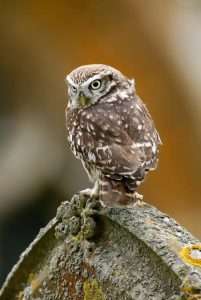
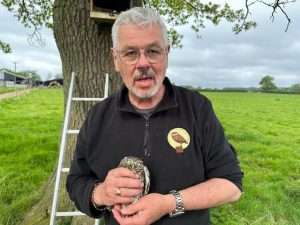
The Little Owl its Past, Present and Future-Roy Leigh- Little Owl Monitoring Network-S.Devon Branch Indoor Meeting 7.30pm-19/10/26
Roy Leigh has been monitoring owls for over 30 years. His talk will cover the introduction of the Little Owl into the UK, its ecology, the current status and the monitoring network he has established to champion the owls’ cause and understand its decline. Roy will share the latest updates in Little Owl conservation and his work with NGOs to establish a conservation plan.
The Courtenay Centre, Newton Abbot TQ12 2QA
Suggested donation for entry £3 Members £4 Non-Members, to include refreshments
Plymouth Branch Visit to East Soar and Starehole Valley – 25th September 2026
Devon Highways did their very best to prevent our meeting taking place at all, by closing several of the roads around Modbury without any adequate diversion signage in place. Every side road in the area was jam packed with regular commuters trying to find their way through only to find many cars and trucks we’d seen earlier going in the opposite direction and saying you can’t get through that way either! All this chaos led to a much delayed start to our birding day, so full marks for perseverance must go to the fourteen branch members that fought their way through to East Soar.
We came in search of migrants, so it was fitting that some of the first birds we saw, above the car park, was a small handful of Swallows. The surrounding scrubby hedgerow was bustling with Linnets and the resident House Sparrows. On the airfield the migrants took the form of three or four Wheatear whilst Stonechats stood guard on the perimeter fence. In the adjacent stubble we could see good numbers of Skylark and Meadow Pipits flitting between their feeding patches. The aerial fly hunt was now joined by twenty or so House Martins, but more of these to come. The hedgerow bird count rose with the addition of Goldfinch, Greenfinch and a stunning male Yellowhammer in amongst the Linnet flock close to East Soar Farm. A single Goldcrest had the ‘Fairy Wood’ all to itself.
The wilIow copse below the farm, that often teems with warblers, was quieter than expected with only a couple of Chiffchaffs, Blackcap, Robin, Blue and Great Tits, and an invisible Wren. A helpful Buzzard on a fingerpost, was pointing our way down to Starehole Valley. However, as time was moving on, so we took our lunch break down beside the ponds, but not before we spotted the first Cirl Buntings of the day.
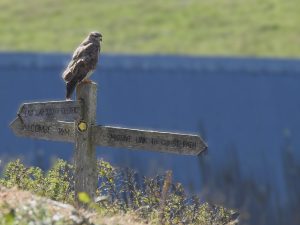
Buzzard directing traffic
Lunchtime was enlivened by the astonishing sight of a mass gathering of hundreds of House Martins in a swirl alongside the highest buttress in Starehole. Other than the Martins the valley seemed eerily quiet so we didn’t linger there for long. Have we come too early for many migrants?
Now we were to follow the coast path back towards Middle Soar when things became quite interesting. Firstly, foraging around the hoofs of a small fold of Hielan’ Kye was a lively party of around ten Yellow Wagtails, watched over from the fence by a Whinchat.
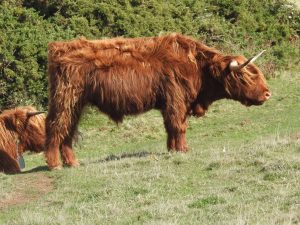
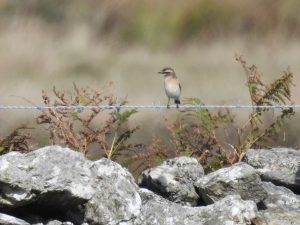
Spot the Yellow Wagtails Whinchat
The real excitement of the day then came when, not one, but two Merlins each gave chase to a couple of Meadow Pipits. The acrobatics of both species was quite astounding to watch. There were mixed emotions within the group, when both Pipits escaped with their lives when the falcons just ran out of energy, but that the Merlins went without their much needed meals as they prepare for their migration over the Channel. One rested a while in a hawthorn whilst it regained its strength ready for the next hunt.
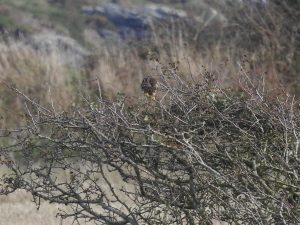
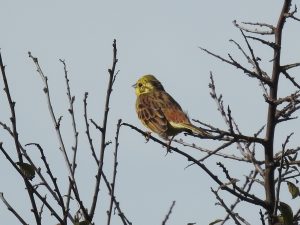
A very tired Merlin juv Yellowhammer – the next meal?
The hedge on the opposite side of the field was now heavy with Linnets, Blackcap, Yellowhammer, Cirl Bunting and Whinchat, any one of which was in danger of being on the Merlin’s menu.
Back at the carpark an immature Buzzard with some very odd markings sparked a heated debate amongst some of the group. When will we ever learn, that this is Devon and very many of our Buzzards just love to be different!
In all, thirty-nine bird species, along with seven butterfly and three dragonfly species, as listed below were seen or heard on the day.
Birds:
Buzzard, Sparrowhawk, Kestrel, Merlin, Herring Gull, Great Black-backed Gull, Woodpigeon,
Great Spotted Woodpecker, Skylark, Sand Martin, Swallow, House Martin, Meadow Pipit,
Pied Wagtail, Yellow Wagtail, Dunnock, Robin, Wheatear, Whinchat, Stonechat, Blackbird,
Blackcap, Chiffchaff, Goldcrest, Wren, Great Tit, Blue Tit, Jackdaw, Magpie, Jay, Carrion Crow,
Raven, House Sparrow, Linnet, Goldfinch, Greenfinch, Yellowhammer, Cirl Bunting, Pheasant
Butterflies:
Large White, Clouded Yellow, Small Copper, Common Blue, Red Admiral, Meadow Brown, Speckled Wood,
Dragonflies:
Beautiful Demoiselle, Emperor, Red-veined Darter
Report and photos
Chris Marcol
East Devon Branch Visit to Shipley Bridge . 24th September 2026
On a beautifully warm morning in hazy sun, eleven members from around the County joined
this walk. We began with good views of Dipper in/on the river, and a Sparrowhawk flew
round overhead. We saw 2 Buzzards, including one that moved along the ridge to the side
of us, hovering at several points – behaviour not seen previously by all of us.
4 tit species (including Marsh Tit), a Meadow Pipit, Goldfinch, Linnet, Blackcap, Chiffchaff
and Willow Warbler were amongst the other records. On the reservoir – scarily low in water
– was a Pied Wagtail, a Cormorant and a Grey Heron; no sign of the Goosanders reported
from earlier in the morning.
Sadly, no Ring Ouzel – too early in the season – but otherwise a good, if not outstanding,
morning’s trip.
Colin Randall
East Devon Branch Visit to Beer Head. September 7th 2026
Following the summer break for trips, seven regular members met at Beer Head on a bright but cloudy morning. The first stop was a group of bushes which produced several small birds, though they were very active and much debate ensued regarding identification, though Chiffchaff was most probable. Walking on through the pasture produced a brief glimpse of a Wheatear, but little else.
The next group of bushes produced Goldfinches but by now the wind was freshening and small birds hard to locate. A Clouded Yellow was a highlight! As we approached the clifftop a juvenile Wheatear on the skyline gave excellent views for all. Peregrines are known to frequent to stacks along the coast here and we quickly located one. Telescopes gave excellent views as the bird sat on the chalky outcrop. Scans over the sea produced a few Gannet and flocks of Herring and Black-headed Gull. Approaching the tower, the appearance of livestock raised hopes of finding Yellow Wagtail, but despite much hard searching none were located. Bushes at the entrance to NT area held a few passerines, but the fresh wind kept them well hidden. The walk back to the car park produced an anticipated Stonechat.
Overall, a total of just under 20 species was disappointing, given that such coastal sites can hold a good variety of migrants on autumn passage.
Andrew Thorpe
PLYMOUTH BRANCH’S VISIT TO EXMINSTER MARSHES AND THE POWDERHAM CHURCH AREA ON TUESDAY 18 AUGUST 2026
After the summer break, it was good see old friends, including members from other Devon Birds groups and welcome some new faces for Plymouth Branch’s visit to Exminster Marshes and Powderham.
We had experienced one of the longest periods of dry weather for some years and the ground and meadows were very dry. No Marshes were to be seen, only few pools of standing water.
We set off along the RSPB path into the reserve. We could hear some of the usual hedgerow birds – Wren and Tits – but all were skulking in the undergrowth. The cronk of a Raven was also heard. Swallows, occasional House Martin, Carrion Crows and Woodpigeon were passing over and the occasional Herring Gull. As we came to the first viewing gate a Marsh Harrier gave us excellent views as it made steady progress from right to left over the greenery across the dry meadow. At the same time there was a large movement of small birds and gulls from left to right flushed by a different bird of prey. The Harrier stayed a while, and a Kestrel was also briefly spotted. A Reed Bunting and several Magpie were seen plus a Buzzard sitting on a post on the far side of the meadow. Several Clouded Yellow butterflies were close to the ground.
Moving on we turned off the main path, accompanied by a Robin, to view the meadows and a small section of fencing backed by some greenery. Families of Swallows and Pied Wagtails were resting on the fence, frequently together. A subtly different Wagtail was, after much discussion, identified as a juvenile Yellow Wagtail. A warbler briefly joined them on the fence but rapidly dropped back, identified as a Willow Warbler. This gave the perfect demonstration of the fascinating and frustrating identification of juvenile birds.
Looking across to a less dry area several Pied Wagtails regularly showed and a few Linnets passed by.
Along the path, there was a Guelder Rose and unusually large bunches of Sloes. While some were watching a native hornet feeding on Water Mint a Whitethroat was heard and eventually found.
Crossing the parched meadow towards Turf, several Cattle Egrets were seen roosting in a tree and later among the cows.
Approaching Turf we could hear and see Starlings on the pub roof, taking off to give us a mini murmuration. In the hedgerows the House Sparrows and Goldfinch were very active. There was also a Mute Swan on the canal.
Divers carrying out underwater maintenance on the lock gates, together with the high tides, meant there was disturbance and no mud). Eating lunch by the lock gates we saw a lone Black-headed Gull. A Grey Seal came to investigate us and entertained us catching a large fish, possibly a grey mullet, in front of the lock gates.
We headed back along the canal path, after the dry brown meadow it was refreshing to see green vegetation and large swathes of yellow Fleabane. A Lapwing sat in the meadow and a juvenile Moorhen on the canal, and a Grey Heron in the distance. At the viewing platform Mallard and Canada Geese could be seen on the pools.
Continuing along the road to the car park, Blackcap and Great Spotted Woodpecker were heard, two Stonechats perched near Rooks and Carrion Crows. A shed grass snake skin was discovered at the side of the road and a mole made a brief appearance in the field next to the car park.
We moved on to Powderham church where Jay and Greenfinch were seen from the carpark. We continued over the cycle bridge to view the falling tide. On the mud were Cormorant, Oystercatcher, Ringed Plover, Dunlin, Curlew, a Sanderling, and a Redshank, and a lone Little Egret in the distance.
Report by Robert Massey
48 Species seen or heard
Mute Swan, Canada Goose, Mallard, Cormorant, Cattle Egret, Little Egret, Grey Heron, Marsh Harrier, Buzzard, Kestrel, Moorhen, Coot, Oystercatcher, Ringed Plover, Lapwing, Sanderling, Redshank, Curlew, Dunlin, Black-headed Gull, Herring Gull, Woodpigeon, Great Spotted Woodpecker, Swallow, House Martin, Pied Wagtail, Yellow Wagtail, Wren, Robin, Stonechat, Blackcap, Whitethroat, Willow Warbler, Blue Tit, Great Tit, Long-tailed Tit, Magpie, Jay, Rook, Carrion Crow, Raven, Starling, House Sparrow, Linnet, Goldfinch, Greenfinch, Reed Bunting.
PLYMOUTH BRANCH’S VISIT TO THE LOWER OTTER RESTORATION PROJECT AT BUDLEIGH SALTERTON ON WEDNESDAY 16 SEPTEMBER 2026
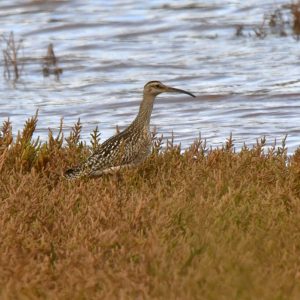
Sixteen members met at the LORP car park on a sunny morning and we were greeted by Rick Lockwood, head warden of this newly established reserve, which is part of the Pebblebed Heath trust group of reserves. He informed us of several species including Green Sandpiper, Knot and Black-tailed Godwit that had been seen recently and for us to keep a watch for them. After a short briefing we set off Easterly across the new bridge from where we could look upstream and downstream seeing Mallards in large numbers flying over heading North. Black-headed and Herring Gulls were observed on both sides of the bridge. A flock of House Sparrow moved through the reedbed before flying off in the direction of the car park and row of houses nearby and a late staying Sedge Warbler was spotted in the same area. Also seen were Little Egret and Oystercatcher, as well as several Little Grebe – both on the open water and the River Otter. In the scrub area on the southern side of the road we had Stonechat, Goldfinch and Meadow Pipit with good numbers of Swallow and House Martin flying overhead. Highlights here included a close up sighting of a Whimbrel and from the old ‘White Bridge’ upstream on the Otter we had a Kingfisher fishing from the overhanging branches of a Willow and Little Grebe and Moorhen also present.
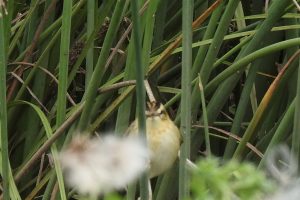
We then walked along the path that runs between the river and the open water seeing Cormorant, Shelduck, Mute Swan , Mallard and Teal. Corvids patrolled the skies above us; species counted being Carrion Crow, Jackdaw, Rook and Raven. One of the islands had a group of Black Headed Gulls, one of which was showing leucistic plumage and provoked some debate as to whether it was a Med Gull! At the top end of the open water is a marsh and just visible through the reeds we saw a Green Sandpiper along the edge of a ditch along with two Grey Heron and Teal and Mallard. Later in the same area a group of Cattle Egret were seen. Passerines included Linnet, Robin, Dunnock, Blackbird and two beautifully glossy Ravens were showing well on the grassy area.
We returned to the car park where we had lunch and Blue, Great and Long Tailed Tits were spotted around the car park area, along with the flock of House Sparrows and several Blackbirds.
A final walk south along the edge of this newly formed channel rewarded us with a Common Sandpiper, Great Black- backed Gull, Ringed Plover and Dunlin.
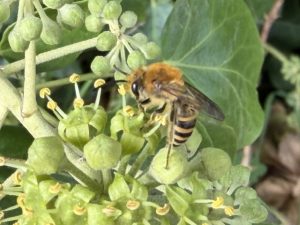
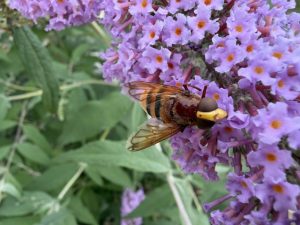
The following non-avian species were seen: Migrant Hawker and Emperor Dragonfly, Small White, Large White, Red Admiral, Clouded Yellow Butterflies, Hornet Plumehorn Hoverfly, Ivy Bee and a Rabbit.
An enjoyable meeting and we were able to appreciate the hard work that has been carried out to construct this reserve and the ongoing efforts by Rick and his team in maintaining the habitats for all wildlife.
Report by John Lloyd
Birds – 48 species seen or heard(h) : Mute Swan, Canada Goose, Shelduck (imm), Mallard, Wigeon, Teal, Little Grebe, Cormorant, Cattle Egret** (11nr), Little Egret, Grey Heron, Buzzard, Moorhen, Oystercatcher, Ringed Plover, Dunlin, Green Sandpiper, Common Sandpiper, Redshank, Whimbrel, Black-headed Gull, Herring Gull, Great Black-backed Gull, Woodpigeon, Collared Dove, Kingfisher, Great Spotted Woodpecker, Swallow, House Martin, Pied Wagtail, Dunnock (h), Robin, Stonechat, Blackbird, Chiffchaff, Sedge Warbler, Wren (h), Great Tit, Blue Tit, Long-tailed Tit, Magpie, Jackdaw, Carrion Crow, Raven, Rook, House Sparrow, Linnet, Goldfinch.
[ ** = Uncommon ]
Mammals: Rabbit
Dragonflies: Migrant Hawker, Emperor. Other insects: Hornet Plumehorn Hoverfly and an Ivy Bee
Butterflies: Large White, Small White, Clouded Yellow, Red Admiral, Speckled Wood
Mid-Devon branch walk at Dawlish Warren, 15th September 2026
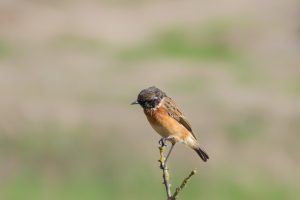
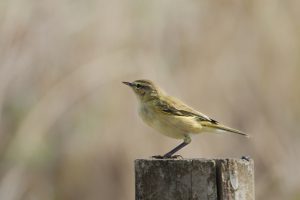
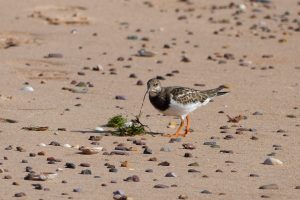
Meeting in the seaward car park (a break from tradition!) so that we could quickly get down to the far end of the beach and over the dunes to view the bight at high tide where there was the promise of a good wader congregation, the ten of us present set off at a fairly rapid pace! We did get a bit strung out on route as people were distracted by various small birds on the Warren, including Stonechat and Chiffchaff, or over the sea, including Gannet and terns. Pied Wagtails and Rock Pipit were on the beach, as were a small group of Sanderling, uncharacteristically standing very still, and a couple of Turnstone on one of the groynes.
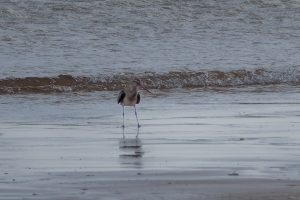
Finally we reached the path up onto the dune ridge where we stopped for a coffee and to scan across the bight and up into the estuary. A good number of Oystercatcher were resting on the opposite sand spit with some Shelduck and a single medium-sized wader that had its back to us and its beak tucked away. Possible Whimbrel? Eventually it did wake up and become a bit more active, revealing itself to be a Bar-Tailed Godwit. Terns were resting on the posts in front the of the old hide, being mostly Sandwich Terns, but one with red legs was a Common Tern and a Little Tern was also seen briefly flying around, so much smaller than everything else, before flying out to sea. As the tide began to recede, flocks of small waders began moving around and landing on the newly exposed shoreline. Mostly Dunlin and Ringed Plover, with some Sanderling as well, but we didn’t manage to locate any Curlew Sandpiper at this point. Another Common Tern, this one with very orange legs, landed on the shore much closer to us, prompting some discussion on tern ID.
We spent quite some time within the dunes, with Stonechat, Wheatear, Greenfinch and Swallow, and then moved back to the beach to sit on some rocks while eating lunch. Becoming quite engrossed in our sandwiches and conversations, some of us almost missed a flock of nine Glossy Ibis which flew in and over the dunes, presumably landing somewhere behind. A few minutes later, they reappeared and flew across to Exmouth and disappeared behind the houses. (Apparently they were then seen a little while later dropping into the Otter estuary at Budleigh, before moving on again after a short while.) Feeling very pleased with this bonus sighting, we headed back along the beach, noting a seal bobbing its head out just offshore. The Bar-tailed Godwit (presumably the same one) was now on the beach, and a small group of Dunlin together with at least one (we think we convinced ourselves, although maybe not entirely!) Curlew Sandpiper.
The walk back across the Warren added very little, with very few birds showing other than a few Stonechat, Linnet and Greenfinch. Clouded Yellow butterflies were still around in good numbers. On passing the field centre, the warden mentioned that a Wryneck had been seen in the morning around the car park. We met a few others looking for it, but it wasn’t showing and we decided that would have to be one for another day!
A total of 50 species seen: Canada Goose, Mute Swan, Shelduck, Mallard, Pheasant, Woodpigeon, Stock Dove, Collared Dove, Oystercatcher, Ringed Plover, Curlew, Bar-tailed Godwit, Turnstone. Curlew Sandpiper, Dunlin, Sanderling, Black-headed Gull, Herring Gull, Great Black-backed Gull, Lesser Black-backed Gull, Sandwich Tern, Little Tern, Common Tern, Gannet, Cormorant, Little Egret, Glossy Ibis, Great Spotted Woodpecker, Kestrel, Magpie, Carrion Crow, Blue Tit, Coal Tit, Long-tailed Tit, Swallow, House Martin, Chiffchaff, Skylark, Rock Pipit, Starling, Blackbird, Robin, Stonechat, Wheatear, Dunnock, House Sparrow, Pied Wagtail, Chaffinch, Greenfinch, Linnet.
Report and photos by Tom Misselbrook
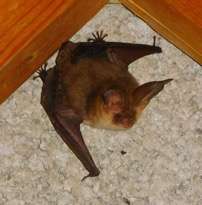
Bats and Ladders; the Good, the Dodgy and the Really Interesting Stuff-George Bemment-S.Devon Branch Indoor Meeting 7.30pm-21/09/26
Author of the book, ‘Bats and Ladders’, George has spent 36 years looking for our British bats and their roosts. She will talk about the species, their roosts and what is actually involved in bat survey work, and what we’ve learnt (or think we’ve learnt) about the greater horseshoe bats of Berry Head.
The Courtenay Centre, Newton Abbot TQ12 2QA
Suggested donation for entry £3 Members £4 Non-Members, to include refreshments
Volunteers needed to help with the running of the Society
Devon Birds Council and other volunteer opportunities
At present the Devon Birds Council is understaffed and new volunteers are required to fill the gaps.
We need a chair and vice chair to become trustees and sit on council, as well as a communications Officer to manage the newsletter and communications with members.
We also have opportunities in managing the website, relationships with other organisations and other admin tasks
These activities needn’t be onerous and volunteers are able to do as much as they are able with no firm commitment on time.
If you are interested, please email secretary@devonbirds.org and we will be in touch about how you can help.

